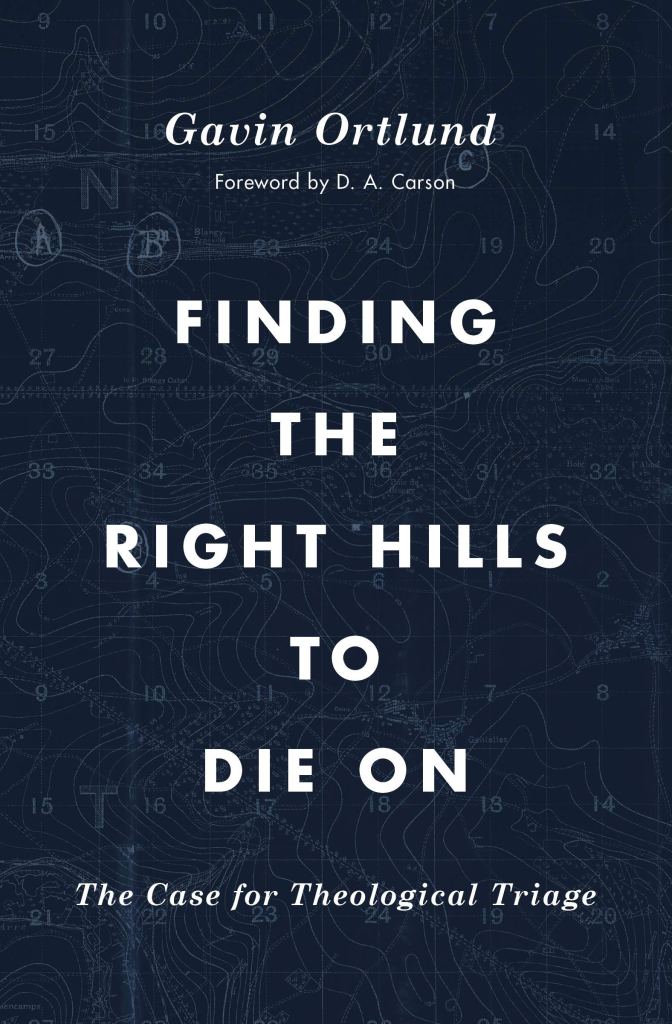
Finding the Right Hills to Die On: The Case for Theological Triage

by Gavin Ortlund

A Short Review

by Liam Walsh

This book will be a paradigm changer for many. It is an absolutely excellent work. Ortlund is navigating the question of what issues are worth drawing dividing lines between Christian groups. One of Jesus’ prayers before going to the cross – and one of the longest prayers in Scripture – (the high priestly prayer) was for the unity of his followers. The unity of the church matters greatly to Jesus. However – Christians have many different views on many things and doctrines. How are Christians to navigate these differences? And if we are to divide, in what way should we divide? 

Ortlund develops a four tiered system for navigating the importance of disagreements between Christians in their doctrinal convictions. All four also have differing ways Christians should divide as well. His four tiered system is as follows:

1. Doctrines which are essential to the Gospel
2. Doctrines which are essential for the health of the church and practice
3. Important doctrines theologically – but not enough to justify separation between Christian groups
4. Issues unimportant to gospel witness and ministry collaboration 

Ortlund has created a very nuanced approach, and has spent much time thinking on and developing his system. Not only do these four tiers contain different theological beliefs, but Ortlund also details 4 ways in which believers are to ‘divide’ over these issues. 

Tier one constitutes a division between Christian believers and unbelievers. It includes issues such as the Trinity, the deity of Christ, the bodily resurrection of Christ, and justification in Christ’s death through faith. Tier one is also the most drastic of all the dividing lines. These issues should be stood and fought for – albeit in a loving, humble, and Christ honoring way. Ortlund also helpfully emphasizes that there are many Christians who hold errant views in this category who are just ignorant of the details – or just haven’t studied these issues yet. He also highlighted the difference in the way one approaches a doctrinal difference as a large indicator as well – humbly, or in an arrogant and prideful way. 

Tier two is a tier for extremely important issues, but not issues that should divide between whether we consider someone a Christian or not. However these issues are the ones that affect much of a persons Christian life. Prayer or sacraments are often greatly affected. 1st tier doctrines which are essential to the gospel can also be affected by these 2nd tier doctrinal beliefs. These issues, he argues, are usually grounds for switching churches or organizations over. Issues that fall in this category for Ortlund are baptism, the lords supper, Calvinism/Arminianism, strong cessationism/strong continuationism, and some nuances in justification (double vs single imputation) for example. However, in saying that a difference in these views can lead to dividing churches, he emphasized that it should not lead to a relational divide between Christians. Our desire to uphold the love and unity of the church should match our desire for truth. As Ortlund puts it, ‘gospel doctrine, and gospel culture should both be upheld equally.’

Third Tier issues were issues which have some importance – but don’t affect the more important doctrines and don’t affect life and practice of believers. Ortlund argues that though these are important issues, Christians should not divide over them. He places in this category the old vs young earth creation debate and some of the end times chronology controversies. Preferences of alcohol consumption he also places here. I personally would also place politics in this category – as something that,  while it is important, it’s not something which Christians need divide over. 

The fourth tier issues are those that are unimportant for life and ministry in the church, and are more simply preference issues. In this category Ortlund places worship styles and other more outward stylistic preferences. 

Reading this, it seemed right on target to me. Granted, my theology lines up with Ortlund extremely closely – but, even so, I’m amazed at the things Christians divide over. Even entire denominations often, divide over very minor theological preference points such as end times views, creation day lengths, or alcohol consumption stipulations. This book was a breath of fresh air – and contains much wisdom in how Christians should approach theological differences. 

In our current climate, with so many churches splitting or dividing over politics, I would have appreciated more conversation on politics and how Ortlund would fit them into this system. However – the book is really one about theology, not politics. So I suppose it’s fitting that it addresses only the former. [Speaking of politics, I couldn’t help thinking that a system like this would be a step forward for any system of beliefs – especially the polarized state of American politics right now. This would allow polarized groups to work together on the issues they agree on even when they have significant disagreements in other areas.]

I enjoyed this very much. This should be read by any Christian who ever wonders which issues they need to take a stand for and which ones to not let divide, but rather make their stand for unity – often in the face of opposition from both sides. It also had me checking my own heart on some particular doctrinal nuances I hold – that I’m particularly proud of – in a not good way..

Jesus Before Jesus

Prophetic Poetry

One of the great turning-points that led me to have a greater awe in the Bible was when I found that the Bible spoke of Jesus before he ever came. The Bible spoke of him hundreds, and almost thousands of years before he came. There are scores of prophecies of Jesus in the Old Testament. My favorite one though, is the twenty-second Psalm.

Psalm 22 depicts the whole crucifixion scene. Here are verses 12-18:

Many bulls encompass me; strong bulls of Bashan surround me;

they open wide they’re mouths at me, like a ravening and roaring lion.

I am poured out like water, and all my bones are out of joint;

my heart is like wax; it is melted within my breast;

my strength is dried up like a potsherd, and my tongue sticks to my jaws;

you lay me in the dust of death.

For dogs encompass me; a company of evildoers encircles me;

they have pierced my hands and my feet- I can count all of my bones-

they stare and gloat over me; they divide my garments among them,and for my clothing they cast lots.

Psalm 22:12-18 ESV

Now let me rehash some of what we read above in case you missed it.

  1. The person speaking here dies at the hands of persecutors (you lay me in the dust of death)
  2. The person here is in deep physical anguish (my heart is like wax; my strength is dried up)
  3. The person here has their hands and feet pierced (they have pierced my hands and feet)
  4. The person’s garments are taken by the persecutors (they divide my garments among them)
  5. The person’s clothing -seemingly a different article of it than above- is also gambled for (for my clothing they cast lots)

The Awe of God’s Foretelling

This is astonishing! In the beautiful mysterious way that Biblical prophecy does, this Psalm startlingly, even pointedly, depicts Jesus’ last moments. What’s even more fascinating, is that not only does it mention his hands and feet being pierced, but it also mentions both the dividing of Jesus’ garment, and the gambling for his cloak. This is detailed in the Gospel of John chapter 19, verse 23:

When the soldiers had crucified Jesus, they took his garments and divided them into four parts, one part for each soldier; also his tunic. But the tunic was seamless, woven in one piece from top to bottom, so they said to one another, “Let us not tear it, but cast lots for it to see whose it shall be.

John 19:23 ESV

Another interesting fact is that this Psalm couldn’t fully represent David, its Old Testament author, because these events do not line up with how David died, or even how he was persecuted.

So how long before Jesus’ crucifixion was this Psalm written? Biblical scholars place the composition of this Psalm in the time of the Davidic Dynasty, somewhere around 1000 BC. But even scholars who push for a later date, date the writing of this Psalm around 587 BC. So this Psalm was written at the latest about 600 years before Jesus underwent crucifixion. Now, what’s incredible about this date, even the later date, is that this is before the practice of crucifixion even existed yet. So the Psalmist mentioning hands and feet being pierced has no natural explanation. (See the featured image above for the Oldest Existing Psalm 22 Manuscript [5/6HevPs Scroll]).

The Consolation of God’s Promise and His Plan

Why would God go through the trouble of announcing this beforehand in this strange mysterious way? Because God delights to fill us with awe at the beauty and mystery of his coming as a man. Jesus quoted this Psalm from the cross. It was one of his last words before he died. He cried out from the cross “My God, my God, why have you forsaken me?” which is the first line of Psalm 22. This was Jesus pointing us to this Psalm, and his death as the fulfillment of it.

This Psalm is the poetry of God, displaying to us the agony of his own suffering for us. It is fitting that the most glorious event in the cosmos was foretold by it’s creator in song. In his infinite mercy, God became a man, was born into human history, and lived a perfectly righteous life, in order that he could take all our sin, shame, condemnation, punishment, and death, – all of it, on himself through the cross, and give us his brilliantly perfect righteous life in place of our own sinful one.

Why was Jesus forsaken on the cross? So that we never will be. We will never be forsaken, left, forgotten, or neglected by him. There no longer remains punishment, shame, guilt, or fear. They were all placed on Jesus in the brutality of the cross. Instead he pours out on us his love, kindness, delight, and nearness. You are so dear to him, that he died for you. There is no more religious working, white knuckling, measuring up, earning, or trying to merit his approval, because his perfect, sinless, earthly life he gives to you; it is counted as yours. You are adored. Your sins are gone. You are free. And you will be an example of the glorious depth of his unparalleled love throughout the ages of eternity future.

Welcome to Stumblingstone Press!

Welcome to Stumblingstone Press! If you want to learn more about this site, please read the About page. I am excited to now have a website for my publishing excursions! Be sure to check out the new release An Authentic Faith: The Epistle of James by Charles Spurgeon. There are still some kinks that I’m working out on the site, so thank you for your patience. Also I’ll be working on getting an Instagram profile up soon! More books are in the works! Explore the site and enjoy – and thanks for checking everything out!